
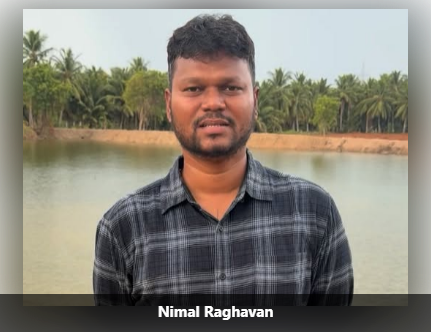
Nimal Raghavan is an Indian environmentalist, social activist, and engineer-turned-organic farmer hails from Tamil Nadu. He is known as the “Lake Man of India” or “Water Warrior,” who left a lucrative tech career in Dubai to spearhead the ecological restoration of over 250 water bodies and the planting of millions of saplings across India and internationally.
Nimal Raghavan Quick Biography
| Gender | Male |
| Full Name/Real Name | Era. Nimal Raghavan |
| Profession | Social Entrepreneur |
| Age | 37 years old |
| Birthplace | Nadiyam Village, Peravurani Taluk, Thanjavur District, Tamil Nadu |
| Religion | Hindu |
| Nationality | Indian |
| Zodiac Sign | Scorpion |
| Height | 5 feet 4 inches (Approx.) |
| Weight | 65-72 kg (Approx.) |
| Hair Color | Black |
| Eye Color | Black |
| Skin Tone | Brown |
| Body Type | Average |
| Father’s Name | Mr. VSV Raghavan |
| Mother’s Name | Shanthi Raghavan |
| Siblings | Private |
| Marital Status | Married |
| Wife’s Name | Sujitha Raghavan |
Biographical Facts About Nimal Raghavan
- Nimal Raghavan is an Indian environmental activist, engineer, social entrepreneur and water-conservation campaigner. He is widely recognized for his efforts to restore neglected lakes, ponds, rivers and other traditional water bodies. Unlike many social media personalities who build their identities around entertainment or lifestyle content, Nimal uses his digital presence to highlight environmental challenges and document community-led restoration projects. His work focuses on water security, sustainable agriculture, afforestation and improving rural livelihoods.

- Instagram Identity: Nimal is active on Instagram under the username @being_nimal. His online identity is closely connected with environmental protection and grassroots development. His posts frequently feature photographs and videos of lakes before and after restoration, ongoing fieldwork, villagers participating in conservation activities and water bodies filling after rainfall. His social media account functions as a platform for documenting progress and encouraging people to understand the importance of protecting natural resources.
- Popular Recognition: Nimal is often described as a Water Warrior because of his sustained efforts to revive water resources and improve water availability in rural communities. The title reflects the central purpose of his work rather than a conventional entertainment or influencer identity. His activities demonstrate how an individual can use technical knowledge, community participation and public support to address environmental problems that directly affect people’s lives.
- Family Background: Nimal comes from an agricultural family. His father was a farmer, and the family’s livelihood was connected with agriculture. In interviews, Nimal has explained that his father’s farming income supported his education and everyday needs. This background helped him understand the importance of farming communities and the natural resources on which they depend.
- Difficult Childhood: Nimal has spoken publicly about experiencing serious difficulties during his childhood. According to an interview published by The Global Indian, his father was diagnosed with a brain tumour when Nimal was only six months old. The family faced considerable financial pressure because of the medical treatment. Nimal also recalled that people in his surroundings sometimes treated him unfairly because of the difficult circumstances affecting his family. These experiences formed a challenging beginning to his life.
- Family’s Financial Struggles: The illness affecting his father created financial uncertainty for the family. His parents had to manage medical expenses while also dealing with the ordinary responsibilities of rural life. Nimal has described how these circumstances affected the family’s financial stability. Such experiences help explain why education and employment became important steps in his journey towards becoming financially independent.
- Determination to Continue: Despite the difficulties surrounding his early life, Nimal continued his education and worked towards building a professional career. His story is an example of persistence through challenging circumstances. Instead of allowing his background to define his future, he pursued engineering and eventually found employment outside his hometown. His later environmental work would bring him back to the region where his journey had begun.
- Educational Qualification: Nimal pursued engineering in Electronics and Communication Engineering at Anna University. His education provided him with a technical foundation and the ability to approach problems through planning and practical solutions. His engineering background later became useful in understanding infrastructure, water management and the technical requirements involved in restoring lakes and other natural resources.
- College Years: Public professional information lists his engineering education at Anna University from 2006 to 2010. His academic journey was an important stage in moving from a rural agricultural background towards a professional career. Engineering offered him an opportunity to develop technical knowledge and pursue employment in different locations. It also gave him a foundation that he could later apply to work outside the conventional engineering sector.
- First Professional Opportunity: After completing his engineering education, Nimal began his professional journey in Pune. His early employment helped him gain work experience and become more financially independent. Moving to another city also exposed him to a different professional environment. Although he eventually became known for environmental activism, his career did not begin in the social-impact sector.
- Working in Dubai: Nimal later moved to Dubai for employment as a software engineer. This opportunity represented an important stage in his professional life because it provided him with an international work environment and greater financial stability. He was building a conventional career while remaining connected to his hometown in Tamil Nadu. At that stage, there was no certainty that he would eventually leave his job and dedicate himself to environmental restoration.
- Connection With His Hometown: Even after moving away for work, Nimal maintained a strong connection with his native region. His hometown was not simply a place where he had grown up; it was also where his family, memories and understanding of agricultural life were rooted. This emotional connection became particularly important when he witnessed the destruction caused by Cyclone Gaja in 2018.
- Cyclone Gaja in 2018: Cyclone Gaja struck parts of Tamil Nadu in November 2018 and caused extensive damage to homes, trees, infrastructure and agricultural land. The Cauvery Delta region was among the areas affected. Nimal happened to be visiting his hometown when the cyclone caused widespread destruction. Seeing the difficulties faced by farmers and residents made him reconsider his priorities and the direction of his professional life.
- A Turning Point: The destruction caused by Cyclone Gaja became a turning point in Nimal’s journey. He saw farmers struggling after losing trees and agricultural resources that supported their families. He also noticed that damaged infrastructure and neglected water resources were making recovery more difficult. Rather than treating the disaster as a temporary problem, he began considering how local communities could rebuild their livelihoods and become more resilient.
- Leaving His Job: Nimal eventually decided to leave his well-paying job in Dubai and remain in Tamil Nadu to work on the problems affecting his hometown and surrounding villages. This was a major professional decision because he was giving up the security of an established engineering career to pursue a challenging social mission. His choice demonstrated how personal experiences can sometimes lead people towards work that has a direct impact on their communities.
- Helping 90 Villages: His initial relief efforts extended beyond his own village. Working with friends, local residents and volunteers, Nimal helped organize assistance for around 90 villages affected by Cyclone Gaja. The activities included clearing roads, supporting the restoration of basic infrastructure, distributing relief materials and planting saplings. This early work helped him understand the importance of community participation in disaster recovery.
- Relief Campaign: Nimal launched a social media initiative called #BounceBackDelta to mobilize support for cyclone-affected communities. The campaign helped gather and distribute essential materials such as clothes, groceries, toiletries and tarpaulin sheets. Social media provided a way to communicate the needs of affected villages and connect supporters with relief activities. The campaign also demonstrated how digital platforms could be used for practical community service.
- Tree Plantation Initiative: Following the initial relief activities, Nimal and his supporters promoted the #DeltaSaplingChallenge. The campaign encouraged tree planting in areas affected by the cyclone. Trees are important for ecological balance, soil protection and local biodiversity. In an agricultural region, restoring vegetation can also contribute to the long-term health of the surrounding landscape. The initiative became one of the early components of his wider environmental work.
- Understanding Water Scarcity: As Nimal became more involved in helping farmers, he recognized that water management was one of the major challenges affecting agricultural recovery. Neglected lakes and ponds were unable to store water effectively, while inadequate maintenance of channels and traditional water systems reduced their usefulness. He realized that repairing agricultural land alone would not be enough without addressing the water resources that supported it.
- The Importance of Lakes: Lakes and ponds play a major role in rural water management. They can store rainwater, support groundwater recharge and provide water for agriculture and other local needs. When these water bodies become filled with silt, invasive vegetation or waste, their ability to retain water can decline. Nimal’s work focuses on restoring these natural and traditional systems so that communities can benefit from them again.
- Formation of KAIFA: Nimal became associated with the Kadaimadai Area Integrated Farmers Association, commonly known as KAIFA. The organization focused on improving conditions for farmers and fishermen through water-body restoration, sustainable agricultural practices, tree planting and related community initiatives. It helped provide an organizational structure for the early work that followed Cyclone Gaja.
- First Major Lake Restoration: One of the important early projects involved restoring Peravurani Lake, a large water body in the Thanjavur region. Reports describe the lake as covering approximately 564 acres and having the potential to support irrigation across a substantial agricultural area. The restoration work involved desilting and strengthening the lake’s structure. Local volunteers participated in the effort, showing how community involvement could support large-scale environmental work.
- Community Participation: Nimal’s approach places considerable importance on involving local residents from the beginning of a restoration project. Villagers understand the local history, water flow patterns and practical needs of their surroundings. Their participation can also help create a sense of responsibility for maintaining a restored lake after the initial work is completed. His projects demonstrate that environmental restoration becomes more sustainable when communities are active participants rather than passive observers.
- Mega Foundations: Nimal founded Mega Foundations, associated with the phrase Make Earth Green Again. The organization works on water conservation, ecological restoration, afforestation and environmental sustainability. Its approach involves collaboration with local communities, government bodies and private organizations. Through this structure, Nimal’s work developed beyond individual relief activities into a wider environmental initiative.
- Water-Body Restoration: The restoration of lakes, ponds and other water bodies is the central focus of Nimal’s environmental work. These projects can involve removing accumulated silt, clearing invasive vegetation, strengthening boundaries, restoring inlet and outlet channels and improving the ability of a water body to hold rainwater. The exact work required depends on the condition and geography of each location. His public posts frequently document these activities through before-and-after photographs.
- Agricultural Benefits: Restoring water resources can have a direct effect on agricultural communities. When lakes and ponds hold water more effectively, they may support groundwater recharge and improve water availability for nearby farms. Better water management can help farmers plan agricultural activities with greater confidence. Nimal’s work is therefore connected not only with environmental protection but also with the economic stability of rural households.
- Work in Ramanathapuram: Nimal’s environmental activities have included work in Ramanathapuram, one of the regions in Tamil Nadu known for water scarcity. Reports have described efforts to restore water bodies and river systems in the area. These activities involved addressing invasive vegetation and improving water retention. The aim was to help communities facing water shortages and support agricultural livelihoods through better management of local resources.
- Restoring Rivers: His work has also extended beyond lakes and ponds to river rejuvenation. River restoration can involve addressing obstructions, improving water flow and protecting the surrounding environment. Such projects require attention to the wider water system rather than focusing on one isolated location. Nimal’s involvement in river-related initiatives reflects his broader interest in restoring natural water networks.
- International Environmental Work: Nimal’s activities have also extended beyond India. The Global Indian reported his work in Kenya, where he collaborated with local organizations and water-related institutions on lake restoration. His efforts in the country earned him the nickname “Wa Muva,” translated as “Son of Rain.” This recognition reflects the importance of water conservation in communities experiencing serious water scarcity.
- Work in Kenya: Kenya became an important international chapter in Nimal’s environmental journey. His work there involved collaboration with local partners to improve water availability and restore lakes. Such projects demonstrate that water scarcity is not limited to one country or region. Different communities may face similar challenges involving rainfall, water storage, agricultural needs and the maintenance of natural resources.
- Environmental Vision: Nimal’s broader vision is connected with the idea that communities should have access to water without facing unnecessary hardship. His public statements have emphasized the importance of ensuring that people do not suffer from hunger or lack of water. This approach connects environmental conservation with human welfare because access to natural resources is closely linked with health, food security and economic opportunity.
- Awards and Recognition: Nimal has received several awards and public recognitions for his environmental work. His professional profile lists the Jal Prahari Award from the Ministry of Jal Shakti in December 2023, along with other recognitions from organizations and institutions. These awards acknowledge the contribution of individuals and groups working towards water conservation, ecological restoration and climate-related initiatives.
- Water Warrior Recognition: Nimal has been publicly recognized as a Water Warrior, including recognition highlighted by The Better India. The title is closely associated with his efforts to revive neglected water bodies and improve water security. It has become a recognizable part of his public identity and reflects the subject around which much of his professional work is organized.
- Best River Rejuvenator: His professional profile also lists a Best River Rejuvenator recognition associated with the International River Congress in Kolkata in 2022. This recognition is connected with the wider field of river and water-resource restoration. It reflects the fact that his work has been acknowledged beyond individual social media communities.
- Youth and Social Impact Awards: Nimal’s public professional profile also lists recognitions such as Youth Icon of the Year, Yuva Ratna, Indian Achievers Award and Beacon 2020. These awards relate to his work in environmental protection, community development and climate-related activities. They represent different stages of his journey from local disaster relief to organized environmental initiatives.
- TEDx Appearance: Nimal delivered a TEDx talk titled “Do NOT stop trying” at TEDxGLAU in December 2022. The talk introduced audiences to his personal journey and the difficulties he experienced before becoming an environmental activist. His story highlighted persistence, determination and the importance of continuing to work towards meaningful goals despite setbacks.
- Public Communication: Nimal uses social media to explain the progress of environmental projects and communicate with people interested in water conservation. His posts often include details about the size of restored lakes, the condition of water bodies before restoration and the improvements achieved through collective work. This communication helps make environmental projects more visible to people who may not have the opportunity to visit the locations themselves.
- Documenting Restoration: Before-and-after photographs are an important feature of his public content. These images can show how a neglected lake changes after vegetation removal, desilting and channel restoration. Visual documentation also helps explain why conservation work matters. A restored water body can become easier for people to understand when they can compare its earlier condition with the results of organized work.
- Recent Restoration Updates: His public posts continue to feature restoration activities in Tamil Nadu, including lakes in the Thanjavur region and other districts. For example, posts have documented the restoration of a 400-acre lake at Kurichi and a 115-acre lake at Kayavoor. Such updates show that his work remains focused on practical projects rather than only public awareness campaigns.
- Religious Harmony: Nimal has also shared environmental initiatives that bring people from different religious communities together. One public update about the restoration of Keeranur Periyakulam Lake described the participation of Hindu, Muslim and Christian prayers at the beginning of the project. The message emphasized unity across religious differences for the common purpose of protecting water resources.
- Environmental Education: Through his public communication, Nimal helps draw attention to issues such as groundwater depletion, neglected lakes, invasive vegetation and the importance of rainwater storage. Environmental education is important because restoration cannot depend only on physical work. People also need to understand why water bodies should be maintained and how everyday actions can affect the natural environment.
Nimal Raghavan Hobbies, Interests and Passions
- Water Conservation: Water conservation is the clearest and most consistently documented interest associated with Nimal. His professional and public activities revolve around restoring lakes, ponds, rivers and other water resources. This work reflects a sustained commitment rather than a casual interest. He has dedicated a major part of his career to helping communities protect and manage the water resources on which their livelihoods depend.
- Restoring Lakes and Ponds: Nimal has a strong professional passion for bringing neglected water bodies back into useful condition. His projects often involve removing silt, clearing unwanted vegetation, strengthening lake boundaries and restoring channels through which water enters and leaves. These activities require planning, technical understanding and cooperation with local communities. His public updates show how much importance he places on this work.
- Protecting Nature: Environmental protection is another major theme in his public identity. His activities extend beyond water storage to include vegetation management, afforestation and ecological restoration. Protecting nature involves understanding how different elements of an ecosystem are connected. Healthy soil, trees, water resources and biodiversity all contribute to the long-term well-being of a region.
- Tree Plantation: Nimal has been associated with tree-planting initiatives, including campaigns launched after Cyclone Gaja. Planting trees can support soil protection, provide habitat for wildlife and contribute to healthier local ecosystems. His interest in afforestation reflects the understanding that environmental recovery should include both water resources and vegetation.
- Organic Farming: Organic farming is one of the areas identified in his professional and organizational work. It involves agricultural practices that emphasize soil health and responsible resource management. His connection with farming communities gives him a practical interest in sustainable agricultural methods. This subject also complements his water-conservation work because farming depends heavily on the quality and availability of natural resources.
- Supporting Farmers: Nimal’s work reflects a strong commitment to helping farmers protect their livelihoods. His early activities after Cyclone Gaja were motivated by the difficulties faced by agricultural families. Supporting farmers involves more than providing temporary assistance; it also requires attention to water availability, agricultural infrastructure and sustainable practices. His work demonstrates the connection between environmental protection and rural economic stability.
- Community Development: Community participation is an important part of Nimal’s approach. He has worked with villagers and volunteers to organize restoration activities and improve local infrastructure. His projects show an interest in building collective responsibility rather than depending entirely on outside organizations. This approach can help communities maintain the benefits of restoration over a longer period.
- Afforestation and Green Spaces: Developing green spaces and planting native vegetation are recurring environmental themes in his work. Restored lakes can sometimes include planted areas and small green zones that contribute to the surrounding ecosystem. Such projects help connect water conservation with broader ecological improvement. His organizational mission also places importance on making communities greener and more sustainable.
- Rainwater Harvesting: Rainwater harvesting is another important subject connected with his environmental activities. Capturing and storing rainwater can help reduce dependence on limited groundwater resources. It can also improve the availability of water during dry periods when natural sources are under pressure. His work demonstrates an interest in practical solutions that communities can adopt according to local conditions.
- River Rejuvenation: Nimal’s involvement in river-related restoration reflects an interest in protecting larger natural water systems. Rivers are connected with agriculture, biodiversity, groundwater and the daily lives of communities. Their restoration requires attention to surrounding land, water flow and human activities. This interest extends his environmental work beyond individual lakes and ponds.
- Learning About Ecosystems: Environmental restoration requires an understanding of how natural systems function. Nimal’s projects involve practical issues such as water storage, invasive plants, soil conditions and the movement of rainwater. His work reflects an interest in learning about the relationship between these elements and applying that knowledge to real-world conservation challenges.
- Exploring Rural Communities: Working in different villages provides opportunities to understand local conditions and the challenges faced by residents. Nimal’s environmental projects have involved communities across different parts of India and outside the country. These experiences can offer valuable insights into local agricultural practices, traditional water systems and the everyday needs of rural families.
- Working With Volunteers: Nimal’s projects frequently involve volunteers who contribute time and effort to restoration work. Building a volunteer network requires communication, coordination and the ability to bring people together around a common goal. His public work suggests a strong interest in collective action and in encouraging individuals to contribute to environmental improvement.
- Creating Environmental Awareness: Sharing information about water conservation and ecological restoration is an important part of his public activity. Social media allows him to communicate the importance of maintaining water bodies to a wider audience. His posts can help viewers understand that environmental restoration is not limited to government departments or specialists; local communities and individual volunteers can also contribute.
- Documenting Field Projects: Photography and video documentation are important parts of his public communication. His updates frequently show the condition of lakes before and after restoration, ongoing work and the return of water to previously neglected areas. These records help communicate the scale of a project and make environmental progress visible to supporters.
- Using Social Media for Social Impact: Nimal’s online activity demonstrates an interest in using digital platforms for practical causes. Social media can connect volunteers, donors, local communities and organizations. It can also help explain the purpose of a restoration project and share its results. His approach shows how online communication can support work that takes place far beyond the digital world.
- Disaster Relief and Recovery: Helping communities recover after natural disasters is another important part of his documented work. His response to Cyclone Gaja included relief distribution, infrastructure support and tree-planting campaigns. This experience reflects an interest in helping people rebuild their lives after environmental emergencies and in developing solutions that can reduce future vulnerability.
- Climate Change Awareness: Nimal’s professional work includes climate-related environmental initiatives. Climate change can affect rainfall patterns, water availability, agriculture and ecosystems. Conservation activities such as restoring water bodies, protecting vegetation and encouraging sustainable farming can contribute to stronger local resilience. His work reflects an interest in addressing environmental challenges through practical action.
- International Collaboration: His work in Kenya and other international environmental initiatives shows an interest in sharing knowledge across geographical boundaries. Water scarcity is a global issue, and different communities can learn from one another’s experiences. Working with local partners allows environmental projects to be adapted to the conditions and needs of different regions.
- Helping Rural Families: The welfare of rural households is closely connected with Nimal’s environmental mission. Water availability affects agriculture, livestock, household needs and local economic activity. By working on water-body restoration, he contributes to projects intended to improve the conditions that support rural life. This interest is a central reason his work extends beyond conservation as an isolated activity.
- Promoting Sustainable Living: Sustainable living involves using natural resources responsibly and considering the long-term effects of everyday decisions. Nimal’s work reflects this principle through water management, tree planting and agricultural initiatives. His public message encourages people to recognize that environmental resources need care and maintenance if future generations are to benefit from them.
- Inspiring Young People: His journey from engineering employment to environmental activism provides an example for young people interested in social impact. His public story demonstrates that technical education and professional experience can be used in different ways. It also encourages young people to think about the problems affecting their communities and consider how their skills might contribute to meaningful solutions.
- Public Speaking and Sharing Experiences: Nimal’s TEDx appearance and public interviews show that communicating personal experiences is part of his wider work. Sharing the challenges behind environmental projects can help people understand why sustained effort is necessary. Public speaking also provides an opportunity to encourage others to participate in conservation and community development.
- Building Environmental Organizations: Developing organizations and campaigns is another important part of his professional interest. Environmental projects often require funding, volunteers, technical planning and coordination with authorities. Organizational work helps bring these elements together. His involvement with KAIFA and Mega Foundations reflects an interest in creating structures that can support conservation activities over time.
- Practical Problem-Solving: Nimal’s engineering background and environmental work both involve identifying problems and developing workable solutions. Restoring a lake requires understanding its condition, identifying the reasons for water loss and deciding what interventions are suitable. This practical approach is a defining feature of his public work and a useful example of applying technical thinking to community challenges.
- Promoting Unity Through Environmental Work: His public messages sometimes emphasize that protecting water resources is a shared responsibility that goes beyond religion, social background or other differences. Environmental challenges affect entire communities, making cooperation essential. His involvement in projects that bring different groups together reflects an interest in using conservation as a common purpose.
- A Long-Term Commitment to the Environment: Nimal’s work is not limited to one restoration campaign or one location. His public activities show an ongoing commitment to improving water resources, supporting agriculture and promoting ecological restoration. The long-term nature of these projects reflects the importance he places on sustained environmental action.
- A Passion for Meaningful Work: The most clearly documented personal passion associated with Nimal is his commitment to work that creates practical benefits for people and nature. His decision to leave an established engineering career and focus on environmental restoration illustrates the importance he places on social impact. Rather than describing unverified leisure activities as hobbies, it is more accurate to recognize conservation, community service and sustainable development as the interests that are publicly evident in his life.
Nimal Raghavan Social Media Profiles
| being_nimal | |
| YouTube | @lala_tales |
| Official Website | megafoundations.org |
| being_nimal |
Nimal Raghavan FAQs
What is the age of Nimal Raghavan?
As of 2026, he is 37 years old. He was born in Peravurani Taluk, Thanjavur District, Tamil Nadu.
What is the height of Nimal Raghavan?
His height is 5 feet 4 inches and weight is about 65-72 kg (Approx.)
Who is Nimal Raghavan’s wife?
He is a married man and his wife’s name is Sujitha Raghavan.
What are some of his recent ongoing projects?
His prominent active projects include the rejuvenation of the Kaivaala Kanmoi near Melur (Madurai) and the restoration of supply canals for the Echur Lake in Kanchipuram.
Does he collaborate with other conservationists?
Yes, he frequently coordinates and cross-shares updates with other prominent lake restoration figures, such as Bengaluru’s well-known “Lake Man” Anand Malligavad.
What challenges does he face on the ground?
He often highlights struggles against local administrative negligence, public littering, and bureaucracy—such as instances where authorities or miscreants let sewage water into freshly cleaned lakes (like the Anai Vizhundhan pond).
How can locals invite him to restore a water body in their village?
People regularly use his Instagram comment section or Direct Messages (DMs) to send location details and invite his team to survey drying water bodies in their respective villages.
Why do people heavily respect his work?
He is highly respected because he steps up to execute massive restoration projects that would typically require significant government machinery, bringing clean water back to agricultural lands and villages after decades of drought.
What did Nimal Raghavan do before becoming a full-time environmentalist?
He was a software developer and tech professional working a stable, high-paying corporate job in Pune and Dubai. He holds a Bachelor of Engineering (B.E.) in Electronics and Communication Engineering.
Why did he choose water conservation over other types of social relief?
While doing emergency disaster relief, he discovered that massive amounts of rainwater (equivalent to decades of city water requirements) were being wasted due to a lack of maintenance of natural reservoirs. He realized that restoring water bodies was the only permanent solution to prevent farmer distress and seasonal droughts.
